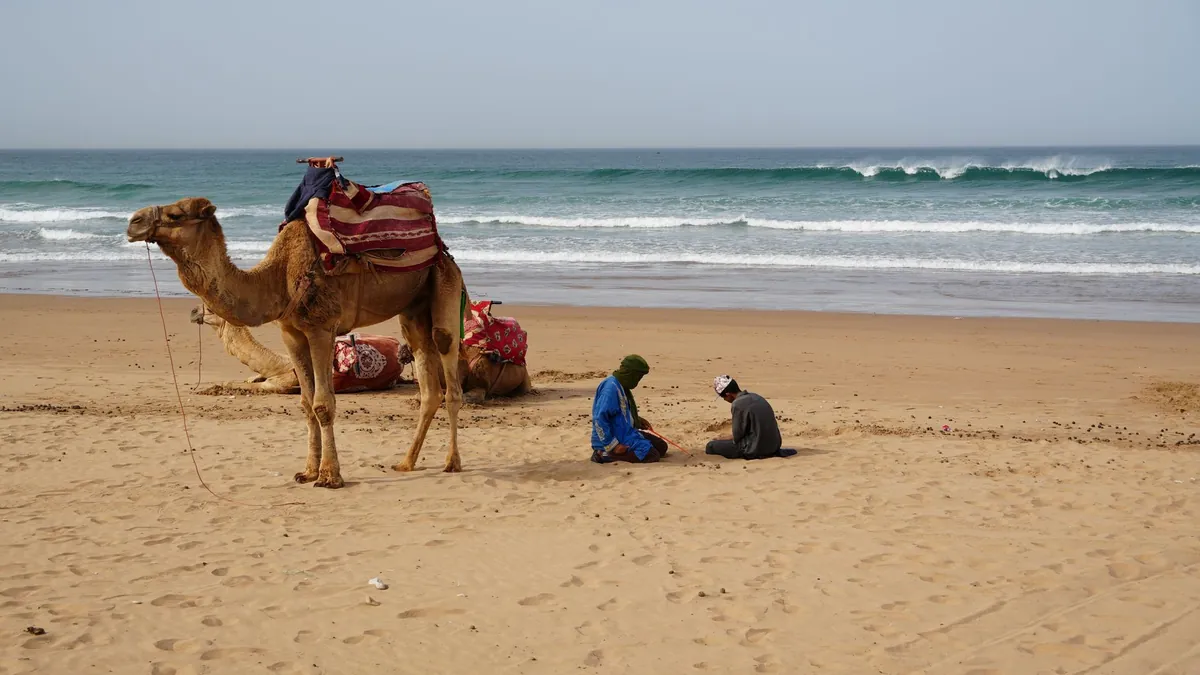
Agadir is not Marrakech, and the connectivity question works differently there. People arrive on charter flights, often as a family, rent a car, and spend a good part of the trip outside the city — Taghazout to the north, Paradise Valley inland, the beaches further south.
That trip profile is exactly what makes a working connection useful, and it is also the profile where sorting it out on arrival costs the most. Here is how to get it right.
What happens when you land at Al Massira
Agadir–Al Massira Airport (code AGA) is about 25 km from central Agadir, roughly a thirty-minute drive. That detail matters: the moment you most need your phone is the journey from the airport to your accommodation — booking a taxi, finding a rental address, messaging a host.
If you plan to buy a local SIM card on arrival, do not expect it to be instant. In Morocco every mobile line must be registered to an identified person: you will need your passport, a form to fill in, and time for activation. When charter flights land together the queue can be long, and that is precisely when you are tired and in a hurry.
The alternative is to leave home with a phone that is already set up. An eSIM installs at home on your own Wi-Fi, with no pressure: you land, switch data on, and you are reachable before you have collected your luggage.
In Agadir itself, coverage is not the problem
Let us be straight about this rather than manufacture a worry: within Agadir, mobile coverage is good. The corniche, the seafront, the marina, the Talborjt district, Souk El Had — you will be connected normally, on 4G and on 5G depending on the area.
So the city is not the issue. It starts when you leave it, which almost every Agadir trip does at some point.
Where it gets patchy: Taghazout, Paradise Valley, the road south
Three destinations come up in nearly every Agadir stay, and each behaves differently:
- Taghazout and Tamraght, about twenty kilometres north. Busy surf villages, decently covered within the villages themselves. The coast road between them alternates between well-served stretches and dead spots.
- Paradise Valley, in the Atlas foothills. It is a steep gorge: the signal degrades as you descend towards the pools and can disappear entirely at the bottom. That is not a fault, it is topography.
- The road south (Tiznit, Mirleft, Sidi Ifni, Legzira). Towns are covered; the stretches between them much less consistently.
The practical consequence is the same whichever provider you use: download offline maps before you set out on an excursion. It is the single precaution that prevents the most trouble, and it is free. Our guide to using Google Maps offline in Morocco covers the steps.
For longer trips inland the principle is the same as in the desert: the network follows roads and settlements, not scenery.
How much data to plan for a week in Agadir
A beach holiday uses less than a touring trip, because part of the day happens on a beach or by a pool, often on the accommodation's Wi-Fi. But two things push consumption back up:
- navigation, if you rent a car and move around every day;
- tethering, very common on a family trip, where one plan serves several devices.
For a typical week, our 7-day plan covers that profile with no arithmetic required: 1 GB per day at full 4G/5G speed, then reduced speed for the rest of the 24-hour period, resetting daily, hotspot included.
| Type of trip | Suggested length | Price |
|---|---|---|
| Long weekend, no car | 3 days | €14 |
| Short beach break | 5 days | €19 |
| Standard week with a rental car | 7 days | €24 |
| Two weeks with trips south | 15 days | €45 |
| Surf season, remote work | 30 days | €79 |
The rental car changes the calculation
In Agadir more than anywhere else in Morocco, a large share of visitors rent a car, and that changes two things.
First, navigation becomes continuous rather than occasional. Second, you regularly find yourself on roads where asking for directions is not an immediate option. A phone that drops to reduced speed still shows you a map; a phone whose data has been cut off does not. That is the argument that matters most here, well ahead of price.
Bring a phone mount and a car charger too: continuous navigation drains a battery faster than anything else you will do.
What to do before you fly, in order
- Check your phone is compatible and not carrier-locked, using our compatibility checker. It is free and takes a minute.
- Install the profile at home, on your own Wi-Fi. On our plans validity starts only on first connection in Morocco, so nothing is used up until you land.
- Download offline maps for Agadir and for anywhere you intend to visit.
- Write your addresses down — accommodation and car hire — so arrival does not depend on having a connection.
Those four steps take under fifteen minutes in total and remove most of the connectivity problems travellers actually hit in Agadir.
From the airport to town: the first hour
Al Massira is a small airport and you clear it quickly. The journey into Agadir, up to Taghazout or across to the hotel zone is by taxi, by a transfer booked in advance, or in a rental car collected on site.
In all three cases the phone earns its keep. In a taxi, to follow the route on a map and confirm you are heading the right way. On a transfer, to find a driver waiting somewhere in the hall. In a rental, to reach a desk that is not always inside the main terminal.
It is also the hour when a connectivity problem costs the most in stress. Arriving with the profile already installed removes that moment entirely: you switch data on as you leave the aircraft and everything works before you reach the baggage belt.
The particular case of night flights
Many charters land late. Operator desks are not always open, there is no morning queue but there are no shops either, and the arrivals hall empties fast. This is the scenario where buying on arrival fails most often, and it is entirely predictable at the moment you book the flight.
Taghazout and the surf season
Taghazout and Tamraght hold a seasonal population of surfers, remote workers and long stays. Two things follow.
First, for a good share of visitors connectivity is a work tool rather than a convenience. Cafés offer Wi-Fi of variable quality, usually congested in the late afternoon when everyone comes out of the water at once. A mobile plan that does not cut off is the safety net that lets a call go ahead.
Second, the surf spots are not in the village. You move between Anchor Point, Banana Beach and Imsouane further north. On those runs coverage follows the road and degrades in the dips. Download the area offline once and it will serve the whole trip: it does not change day to day.
For a stay of several weeks the 30-day plan is the cheapest per day, and it avoids renewals in the middle of the trip.
The day trips from Agadir, one by one
Four excursions appear in almost every stay, and they behave very differently on the network.
- Paradise Valley. An hour inland, then a walk into a gorge. The signal disappears as you descend. Download maps beforehand and agree a meeting point before the group separates.
- Souss-Massa National Park. A protected area to the south, decent coverage on the main roads, patchy inside the park itself.
- Immouzzer and its waterfalls. Mountain road, tight bends, widely spaced villages. The network comes and goes; offline navigation is essential if you are driving.
- Legzira and Sidi Ifni. Over two hours south. The towns are covered, the stretches between them far less so. The most exposed of the four.
The general principle holds whichever provider you use: check coverage before you travel and prepare offline maps for the mountain sections.
When the accommodation Wi-Fi is enough, and when it is not
Hotels in the beach zone and riads in the centre almost all offer Wi-Fi. Quality varies enormously, and three situations defeat it predictably.
By the pool and on the private beach, the room signal does not reach. Late in the day, bandwidth is shared among every guest who came back at the same time. In rental apartments, the line is often domestic rather than commercial and therefore prone to drops.
A mobile plan does not replace Wi-Fi for downloading a film. It replaces it perfectly for what actually matters while travelling: maps, messaging, booking a table, calling home.
How many days to buy, by type of trip
An Agadir stay comes in three shapes, and the plan length should follow the shape rather than the number of nights booked.
All-inclusive hotel or club. You spend most of the time on site with the property's Wi-Fi, and mobile use concentrates around excursions. A plan covering the stay is plenty, with no need to oversize.
Rental plus car. The profile changes: navigation becomes daily and hotspot sharing is often in play. This is the heaviest of the three, and the case where a plan that slows rather than stops makes the real difference.
Long stay or remote work. Length dominates everything else: the longer the plan, the lower the cost per day, and the fewer renewals you have to manage mid-trip.
What to bring, beyond the plan itself
Three objects do more for your connectivity in Agadir than any choice of plan.
A car phone mount and a car charger: continuous navigation empties a battery in a few hours, and a dead phone on the road to Legzira is a genuine problem. A power bank for excursion days, when you will be far from a socket between breakfast and the drive back.
And a habit rather than an object: write your accommodation address and the car hire number on paper. It feels trivial right up until the phone dies on arrival, and it costs nothing.
Agadir compared with Marrakech
If you have been to Marrakech, adjust your expectations in two directions.
Agadir is easier in the city: a modern grid, wide streets, no medina to get lost in, and a seafront where navigation behaves predictably. The classic Marrakech problem of losing signal and orientation simultaneously inside the souks does not really occur here.
Agadir is harder outside it. Marrakech day trips mostly run on well-served roads towards the Atlas; Agadir trips run along a coast and into gorges where coverage is genuinely patchy. The offline preparation matters more here, not less.
In short
Agadir asks for less caution than Marrakech inside the city and more outside it. Coverage is good along the corniche, the marina and Souk El Had; it becomes patchy the moment you take the road north to Taghazout, inland to Paradise Valley, or south towards Sidi Ifni.
The four steps that settle most of it take a quarter of an hour and all happen before take-off: check the handset is compatible, install the profile at home, download offline maps, and write the addresses down. The rest is a question of plan length, and length follows the shape of the trip rather than the number of nights booked.
One last practical point. Agadir's season runs long — it is a winter-sun destination as much as a summer one — so the airport is busy at hours when a European airport would be quiet. That cuts both ways: more flights arriving late, and more people in the same queue when they do. Preparing the phone beforehand is worth more here than in most destinations for exactly that reason.