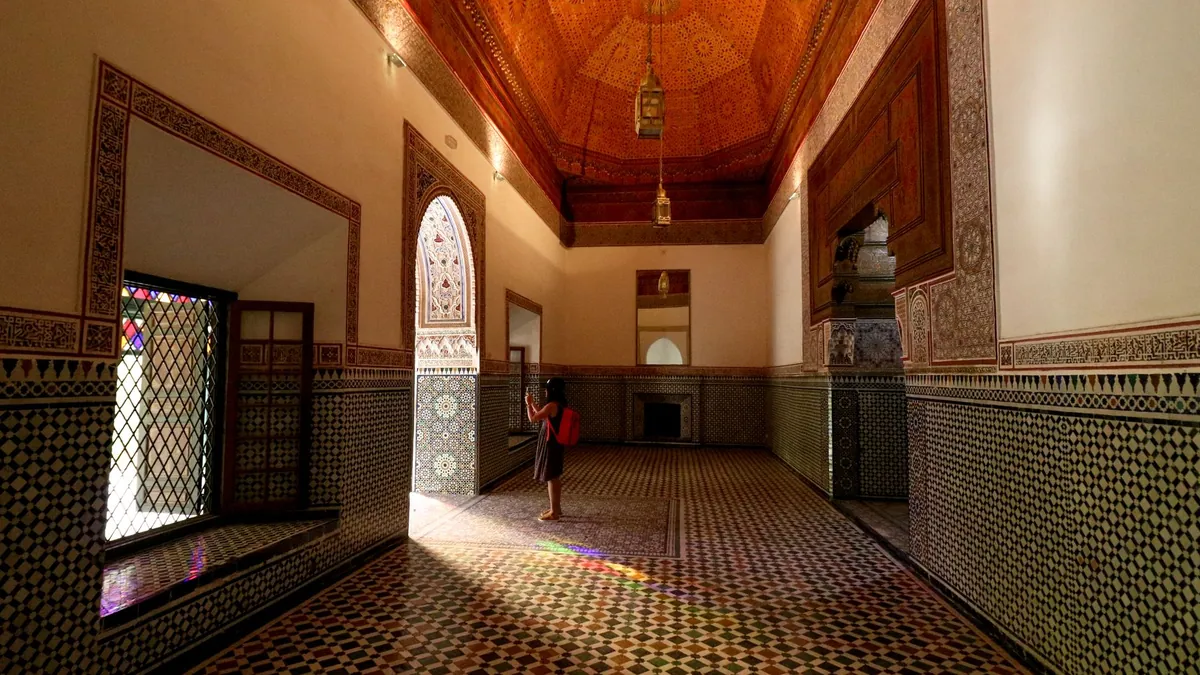
The 37th Marrakech International Marathon takes place on Sunday 31 January 2027. It is one of the few big-city marathons where you can run past a 12th-century minaret at sunrise and be eating lunch in an orange grove by noon — and it draws several thousand international runners into the city for a single weekend.
This guide covers the confirmed schedule, what to do about your phone, and the one piece of admin most first-time visitors get wrong. If you want the short version: your phone needs to work from about 06:00 on race morning, and sorting that out before you fly costs less than a taxi to the start.
Marrakech Marathon 2027: the confirmed schedule
All of the following is published by the organiser on the official race site:
- Marathon (42.195 km): Sunday 31 January 2027, start 07:45.
- Half marathon (21.1 km): Sunday 31 January 2027, start 09:15.
- Course For All (5 km fun run): Saturday 30 January 2027, start 09:00.
- Bib collection: Thursday 29 and Friday 30 January, 09:30–19:30, at Koutoubia Square.
- Online entries close: 24 January 2027.
A valid passport is required to enter Morocco. Check your own country's entry rules before you book — many nationalities, including EU, UK, US, Canadian and Australian passport holders, do not need a visa for short stays, but that is your responsibility to confirm, not the race organiser's.
Dates and times occasionally shift. Confirm on the official race site before booking non-refundable flights.
Why the 5 km on Saturday changes your travel plans
A lot of runners book Saturday-to-Monday and then discover the bib collection window closed on Friday evening. If you are running the marathon or the half, you need to be in Marrakech by Friday 30 January at the latest, and realistically Thursday if you want a calm race weekend. That makes the trip four to five days for most people, not two.
It matters for connectivity too: four to five days is exactly the window where a short data plan is cheapest, and where roaming is most likely to catch you out.
What your phone actually has to do on race weekend
Runners underestimate this. Over a race weekend in a city you do not know, your phone is doing a lot of work:
- Getting to the start at 06:30. The medina is a maze and taxi apps need data. Jemaa el-Fnaa to the start area is walkable, but only if your map loads.
- Finding your family on the course. Live location sharing is the single most useful feature of race weekend, and it needs a working connection on both sides.
- Live tracking and watch sync. Garmin, Coros and Strava all want to upload at the finish. So does everyone else within 200 m of the finish line, which is why a plan with a real allowance beats a stingy one.
- The practical stuff. Confirming your riad booking, translating a menu, checking the forecast — late January in Marrakech is usually 10 °C at dawn and around 18–20 °C by mid-afternoon, so you will want to check before choosing what to wear at the start.
The honest cost comparison
Here is what five days of mobile data costs, compared like for like. Every provider figure was read from that provider's own Morocco page on 27 August 2026.
| Option | 5 days of data | What you actually get |
|---|---|---|
| eSIM Maroc | €19 | 1 GB/day at full speed, then 512 Kbps |
| Holafly | €21.50 | Unlimited, fair-use throttling |
| Airalo | €26.00 | Fixed data bucket |
| Orange France roaming pass | €19.99 | 5 GB total, then out-of-bundle rates |
| Orange France, no pass | 13,31 €/MB | Out-of-bundle rate for Morocco |
Two things worth saying plainly.
First, the last row is not a typo. 13,31 € per megabyte is Orange France's published out-of-bundle rate for Morocco. Downloading a single 40 MB offline map on that rate would cost over 530 €. This is the bill people post about after a race weekend, and it is entirely avoidable — either buy your operator's roaming pass, or use a local plan.
Second, if you are a Free Mobile customer on the Max plan (29,99 €/month, or 19,99 € with a Freebox), Morocco data has been included at no extra cost since March 2026. You do not need to buy anything from us. We would rather tell you that than sell you a plan you do not need.
Which plan length fits the race weekend
Most runners fly in Thursday or Friday and out Monday. That is a 5-day plan at €19. If you are coming in on Saturday for the 5 km and leaving Monday, the 3-day plan at €14 covers it. Staying on afterwards for the Atlas or Essaouira? The 7-day plan is €24 and the 10-day is €32.
Every plan is 1 GB per day at full 4G/5G speed, then 512 Kbps for the rest of that 24-hour period, resetting every day. There is no total cap and the connection is never cut off — so if you burn through a gigabyte uploading race photos on Sunday afternoon, messaging and maps still work, just more slowly, and you are back at full speed the next morning.
Set it up before you fly
An eSIM is a QR code, not a physical card. You buy it, it arrives by email, and you install it while you still have Wi-Fi at home. It activates when you first connect in Morocco, so buying a week early costs you nothing.
Do this at home, not at the airport:
- Check your phone supports eSIM — most phones since the iPhone XS and the Galaxy S22 do, but not all regional variants.
- Install the profile on your home Wi-Fi. Do not delete your normal SIM; the eSIM sits alongside it and you keep your usual number for calls and bank SMS codes.
- Download an offline map of Marrakech anyway. Belt and braces costs nothing.
- Set your home SIM's data to off once you land, so nothing roams by accident in the background.
A last practical note
The finish area around the Menara gardens is busy, loud and full of people trying to upload the same photo. Agree a meeting point with your family before the race rather than relying on finding each other by phone in the crowd. Then use the phone as the backup, which is what it is good at.
Good luck. It is a fast, flat, genuinely beautiful course, and the orange trees are in fruit in January.