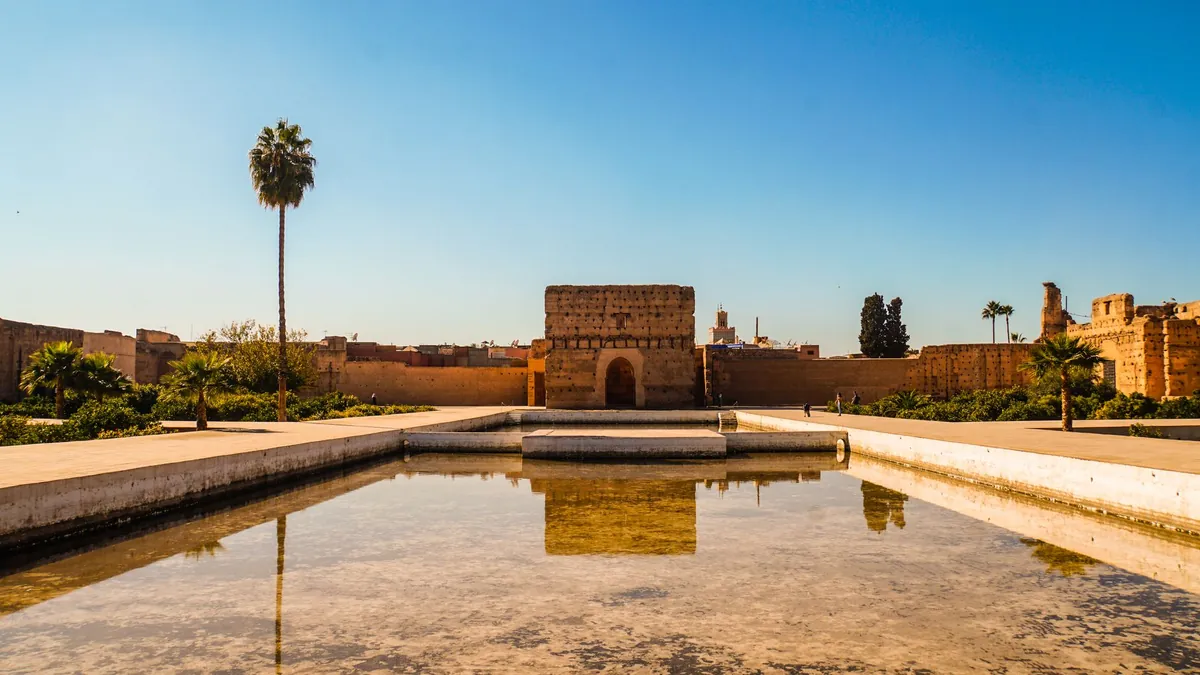
The 23rd Marrakech International Film Festival runs from 20 to 28 November 2026. This edition is presided over by Oscar-winning director Bong Joon-ho, with tributes to Jodie Foster and Guillermo del Toro, and a programme of 82 films from 31 countries.
It is, quietly, one of the best weeks of the year to be in Marrakech. The weather has turned — November days sit around 22 °C, evenings around 12 °C — the summer crowds have gone, and the city fills up with people who are there for something specific.
Programme details and dates are confirmed by regional press but can change. Check the official festival site before booking non-refundable travel.
What the festival is actually like
Two things surprise first-time visitors.
The first is that a large part of it is free and outdoors. The festival has a long tradition of public screenings on a giant screen in Jemaa el-Fnaa, where several thousand people watch together in the open air. You do not need a badge, an invitation or a ticket for those.
The second is that the ticketed screenings, at the Palais des Congrès and the Colisée cinema, are genuinely accessible to the public rather than industry-only. Tickets are released close to the festival and go quickly. If you are planning around specific films, you will be refreshing a website on your phone at an awkward moment — which is the practical reason this article exists.
Why connectivity matters more here than on a normal city break
A film festival is a schedule problem. Over nine days you are constantly checking what moved, what sold out, where the venue is and how long the taxi will take. Specifically:
- Ticket releases and schedule changes happen online, often at short notice, and you will not be near Wi-Fi when they do.
- Venues are spread across the city. The Palais des Congrès is in the Hivernage district, Jemaa el-Fnaa is in the medina, and the gap between them is a 20-minute taxi in traffic. Ride-hailing apps need data.
- Riad Wi-Fi is unreliable by design. Thick walls, courtyards and one router. It is charming and it is not a connectivity plan.
- Evening screenings finish late. Being able to call a taxi at 23:30 from a venue you do not know is worth more than the plan costs.
What nine days of data costs
| Option | 10 days of data | What you actually get |
|---|---|---|
| eSIM Maroc | €32 | 1 GB/day at full speed, then 512 Kbps |
| Holafly | €38.90 | Unlimited, fair-use throttling |
| Airalo | €40.50 | Fixed data bucket |
| Airport SIM card | varies | Passport registration, queue on arrival |
A note on the last row. Buying a local SIM at Marrakech Menara airport is a perfectly reasonable option and we are not going to pretend otherwise — it is often cheap. The trade-offs are that you queue on arrival, you hand over your passport for registration, and you swap out your home SIM, which means your usual number stops receiving calls and bank verification codes. An eSIM sits alongside your existing SIM instead, so you keep both.
And the honest caveat we put on every one of these comparisons: if your home plan already includes Morocco, use it. Free Mobile's Max plan (29,99 €/month, or 19,99 € with a Freebox) has included Morocco data at no extra cost since March 2026. Check your own plan before buying anything.
Which plan fits the festival
The festival is nine days. If you are there for the whole thing, the 10-day plan at €32 covers it with a day of margin. Most people come for a long weekend in the middle — that is the 5-day plan at €19 or the 3-day at €14.
Every plan gives 1 GB per day at full 4G/5G speed, then 512 Kbps for the remainder of that 24-hour period, resetting daily. There is no total cap and the connection is never cut. Practically: you can stream trailers and upload photos freely, and on the day you overdo it, messaging and maps keep working.
Practical notes for the week
- Book accommodation early. Festival week is one of the tightest weeks of the year in the medina, alongside the New Year period.
- Dress for a 10-degree swing. 22 °C at lunchtime and 12 °C outside a late screening are different propositions.
- The Jemaa el-Fnaa screenings are standing-room and very busy. Agree a meeting point with your group rather than relying on finding each other by phone in a crowd of thousands.
- Set up your eSIM at home. It arrives as a QR code by email, installs over your home Wi-Fi, and only activates when you first connect in Morocco — so buying it early costs nothing. Check your phone supports eSIM first.
If you only remember one thing
Turn off data roaming on your home SIM the moment you land, and let the eSIM carry the week. The festival will move a screening on you at least once, and you want to find out by notification rather than by arriving at an empty cinema.